How does email to notes work?
Every Harbor account gets its own private email address — something like janedoe.k3f9qzab@m.harbor.my. Forward an email to it and it lands in Harbor as a normal note: the subject becomes the title, the body becomes the note, and any attachments come along — OCR’d and searchable like anything else you add.
It’s the lowest-friction capture there is. No app to open, no clipper, no copy-paste. Forward the receipt, the flight confirmation, the contract, the long email you’ll want findable in five years, and move on.
Where to find your address
Open Settings → Profile and look for the Email to notes card. Copy puts the address on your clipboard.
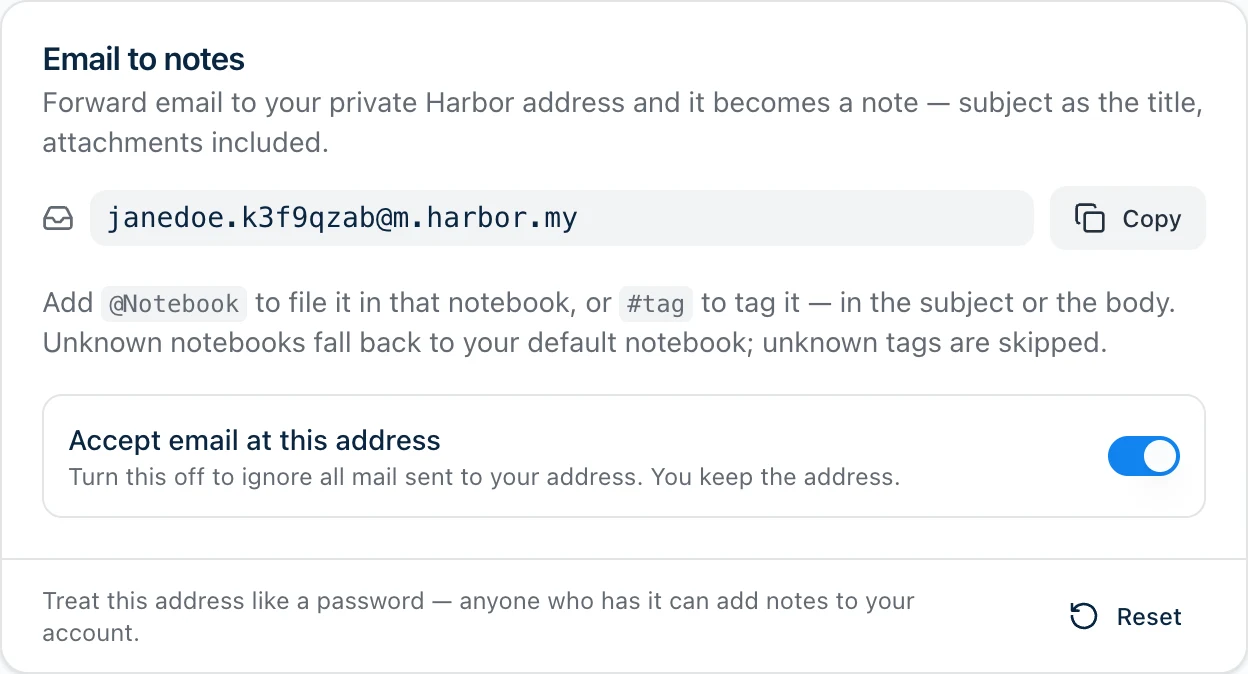
It’s in the same place in Harbor’s Mac, iPhone, iPad, Android, and Windows apps.
Your address is a secret — treat it like a password
Anyone who has your address can create notes in your account. That’s the whole security model: holding the address is the permission. There’s no second step, no login, no approval.
And here’s the part that surprises people, so it’s worth saying plainly: the address is not a password and it’s not a token. Signing out doesn’t revoke it. Changing your password doesn’t revoke it. Removing a device, or disconnecting an app you’d connected to Harbor, doesn’t revoke it either.
Resetting the address is the only way to revoke it. If it ever ends up somewhere it shouldn’t — pasted in a shared doc, CC’d onto a thread that got forwarded around, sitting in a mailing-list archive — reset it.
Harbor helps where it can: your address is shown only on your own profile, only to you, and only inside Harbor’s own apps. A third-party app you’ve connected to your account never receives it, so it can’t quietly keep a way in after you disconnect it.
Only you can send to your address
Harbor accepts mail only from your own verified Harbor email address — the one you sign in with. Anything from another address is dropped silently: no bounce, no error, no note. Nothing appears in Harbor at all.
If you’ve ever forwarded something from your work account and watched nothing show up, this is why. Forward from the address on your Harbor account instead.
The silence is deliberate. A From: line is trivially forged, so bouncing rejected mail would confirm to a stranger that the address is live — and would spray those bounces at whoever they forged. Quietly dropping it is the safer answer.
A few things that follow from this rule:
- Send from your Harbor sign-in address. If you’ve just changed your email in Settings, confirm the new address first — an unconfirmed address doesn’t count yet.
- Manual forwards work; automatic ones usually don’t. A server-side forwarding rule or a mailing list passes the message along carrying the original sender’s address, not yours, so Harbor drops it. Forward it yourself instead.
- Your email provider needs to publish DMARC, which is what lets Harbor trust that a
From:line really is you. Gmail, Outlook, iCloud, and Fastmail all do. If you send from your own domain and mail isn’t arriving, that’s the first thing to check.
What turns into what
| The email | Becomes |
|---|---|
| Subject | the note title (with any @Notebook / #tag stripped out) |
| Body | the note content |
| Attachments and inline images | note attachments — real files, OCR’d and searchable |
A message with no subject takes its title from the first line of the body. Attachments are added at the end of the note. If one attachment is too large it’s skipped on its own — the note still arrives with everything else.
Emailed notes always arrive unencrypted, even into a notebook you’ve set to encrypt by default. Harbor never holds your keys, so our server genuinely can’t encrypt on your behalf — see How does encryption work in Harbor? You can encrypt the note yourself once it’s in.
Filing it as it arrives: @Notebook and #tag
Two tokens steer where the note lands. Put them in the subject or the body:
@Notebookfiles the note in that notebook. The first one wins — a note lives in one notebook.#tagapplies a tag. You can use several.
Matching is case-insensitive, and names with spaces go in quotes: @"Home Office", #"Q3 taxes".
So a subject like:
Furnace warranty @"Home Documents" #warranty #hvac
files the note in Home Documents, tags it warranty and hvac, and titles it Furnace warranty.
Notebooks and tags are never created this way
If the notebook doesn’t exist, the note goes to your default notebook. If a tag doesn’t exist, it’s skipped. Harbor never creates a notebook or tag from an email.
That’s on purpose. Email is unattended — you’re not watching when it arrives — and a single typo would leave a permanent #warrenty in your account forever. Worse, anyone who got hold of your address could flood it with junk structure. So email files into things you already have, and nothing else. (An Evernote import is different — that does create notebooks and tags, because you’re right there watching it happen.)
Tokens in the body are read carefully
A body is full of quoted replies, signatures, and forwarded chatter, so Harbor is conservative about what it treats as an instruction there:
- A token has to be a standalone word — the
@or#at the start of a line or right after a space. That alone keepshttps://example.com/page#sectionfrom tagging anything. - An
@token that looks like an email address is ignored, sobob@example.comin a signature never files your note into a notebook called “example.com”. - A
#tag in the body must contain a letter, so#1and#2in a punch list stay prose. - Only the plain-text version of the body is read, never the HTML — markup is full of
#and@no human typed.
And once an instruction is carried out, it’s removed: a @Notebook or #tag you typed above a forward disappears from the note body, the same way subject tokens disappear from the title. Tokens that didn’t match anything stay put as ordinary text, and Harbor never edits the quoted message below your own lines.
The subject is taken at face value: you wrote it deliberately, so Harbor doesn’t second-guess it.
When Harbor emails you back — and when it doesn’t
A clean delivery sends you nothing. The note showing up in Harbor is the confirmation. If you’re waiting for a “we got it” email, it isn’t coming, and nothing has gone wrong.
You’ll get exactly one heads-up email when something in the subject didn’t resolve:
- an
@Notebookthat doesn’t exist — telling you the note went to your default notebook instead, or - one or more
#tagsthat don’t exist — telling you which ones were skipped.
Unresolved tokens in the body are silent. They’re honored when they match something and treated as ordinary prose when they don’t — otherwise every forwarded thread mentioning @everyone would land another email in your inbox.
Resetting your address
Reset when the address has leaked, or when it starts collecting mail you didn’t send.
Settings → Profile → Email to notes → Reset. Harbor asks you to confirm first:
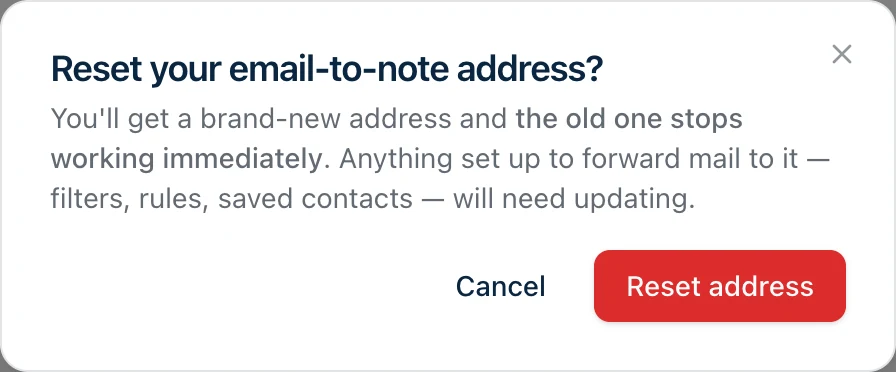
The old address stops working immediately. There’s no grace period and no forwarding from the old one, so anything you’d pointed at it will quietly stop delivering — a mail rule, an inbox filter, a saved contact, a scanner set up to email documents in. Update those right after you reset, or mail will vanish without a word.
You’ll keep the readable first half of the address; only the random part changes. Resetting doesn’t change whether the address is switched on.
Turning it off
If you’d rather not have the feature at all, switch Accept email at this address off. Mail sent to your address is dropped from then on.
The address doesn’t disappear — it stays on the card, marked Off, and switching it back on gives you the same address back. Nothing to re-copy, nothing to re-configure.
Other quick ways in
- The Web Clipper saves web pages in a click from Chrome, Edge, Firefox, or Safari.
- On the Mac, Quick Capture sits in the menu bar behind a global hotkey.
- On iPhone and iPad, the document scanner turns paper into searchable notes.
- A watched folder imports anything dropped into it — the better answer for a scanner that saves files rather than emailing them.
Related questions
Need more help?
Still stuck? Send us a message and a real person will get back to you.